How do M&A advisors get paid?
We only charge a success fee: no retainer, no upfront costs, and if your company doesn't sell, you don't pay us. Many advisors and investment banks charge a monthly retainer on top of their success fee. We chose not to, so that our interests are the same as yours: the better the deal, the more we earn. We're after the best deal for you, not the quickest one.
It also means you get honest advice from us, with no bias. From the first call, we're transparent about what's realistic for your company and when. If you can get what you want now, we'll go for it. If waiting would get you a better offer, we'll tell you, along with the steps to get there, and we'll pick the right moment together. We're not in the business of wasting your time.
What size of company do you work with?
There's no hard cap. We mainly work with companies with annual revenue from around $5m to $100m, but we also work with smaller and larger ones.
Can I sell part of my company?
Yes. We handle full and partial exits, including majority and minority stakes. The right structure depends on what you want to achieve, and often on the buyer, so it pays to keep an open mind. We've seen founders set on a full exit decide to stay on and roll over equity because they believed in the buyer's plans, and others who wanted a minority deal choose to sell in full. We also occasionally help with fundraising, so feel free to ask.
Do you work with funds selling a portfolio company?
Yes, we regularly work with funds on portfolio company exits. That can be a one-off sale, or regular portfolio reviews that include a longer-term exit strategy for each company. Tell us about your portfolio and we'll take it from there. And if you're also looking to acquire, see what we offer buyers.
What does an M&A advisor do?
An M&A advisor runs the sale of your company with you, from start to finish. That means getting the business ready, preparing the materials buyers need, finding and approaching the right buyers, managing the conversations, negotiating the best terms and seeing you through due diligence to signing. See how a sale runs.
What is the difference between a business broker and an M&A advisor?
Broadly, business brokers tend to be transaction-focused: they work on volume and aim to close deals quickly. An M&A advisor works more like a partner. Beyond running the sale, they help you get your business into the best position for it, advise you on timing and structure, and stay closely involved through negotiation and due diligence, with the best outcome as the goal. Every firm works differently, of course, so this is a general picture.
How long does it take to sell a company?
As a rule, plan for 9 to 18 months, but it varies a lot. We've seen companies sell in a couple of months, though that's rarely ideal, and others take much longer. Most of it comes down to how ready your business is for a sale and how much preparation it needs. Exploring the strategic fit with some buyers can also take time, and due diligence takes longer when the business is more complex. That's also why it's best to talk to an advisor long before you plan to sell. Before we start, we'll give you an overview of the timeline for your business.
When should I start talking to an advisor?
Earlier than most founders think: ideally 18 months to two years before you want to sell. Even if a sale feels far off, an early conversation helps you know what buyers will look for and what to work on in the meantime. It costs nothing and commits you to nothing.
Which sectors do you work in?
We work across sectors. We have deep roots in tech, from software and SaaS to IT and tech services, but we also work with consumer brands, industrials and more. Our buyer reach isn't tied to one niche: we track a broad universe of corporates and investors across industries, so we can find the right buyers for your business, whatever your sector.
Which regions do you cover?
We're a global team with offices on several continents, and our investor and founder networks are global too. We see M&A as a global game: buyers often look abroad to grow, so the right one may not be in the region you'd expect, and your advisor doesn't need to be based where your buyer is. That's why global reach has been at the core of Nextoria from the start. Our relationships, buyer intelligence and technology help us find the right buyers wherever they are, and we're very comfortable running cross-border deals.
Is the process confidential?
Yes, and we treat it as a priority. We control what information goes out, to whom and when, and our rule is simple: we only share what needs to be shared. Your company's name never goes out in a mass email to a list of buyers. At the start, we walk you through the safeguards we'll put in place for your sale.
A buyer has approached me. Do I need an advisor?
Running a sale is demanding, even when the buyer comes to you. If you decide to handle it yourself, here's what we'd recommend keeping in mind:
- Don't negotiate with one buyer alone. Talking to a single buyer leaves them with all the negotiating power and gives you nothing to compare against. Make it clear you have other options, and get other opinions. Some buyers will also set a "take it or leave it" deadline. That's often just pressure, because one-on-one suits them.
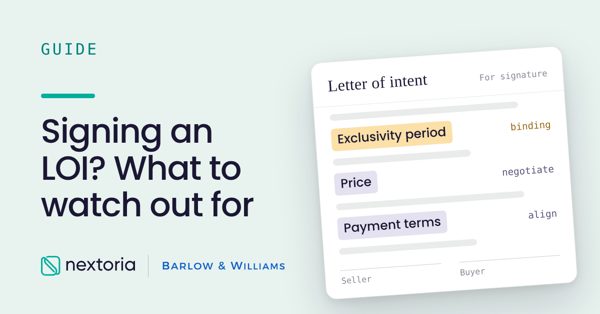
- Don't rush into an LOI. Some buyers will push for a quick signature with an attractive headline offer. Once you sign and enter exclusivity, you lose most of your leverage, so settle every important term first: the structure, how much is cash, equity or earn-out, the warranties and your role after the sale. Anything left open is likely to come back to bite you.
- Expect it to take a lot of your time. Due diligence is intense. Buyers do it all the time and you don't. Ideally, have someone from your team handle it rather than you, so you can stay focused on running the business. The last thing you want during a sale is your performance slipping.
- Bring in the right specialists. You'll need an experienced M&A lawyer and tax advice, ideally before terms are agreed, not after.
We're biased, of course: we believe you're better off with an advisor. But whatever you decide, we're happy to look at the offer with you and give you our honest view, free and with no strings attached.
What is my company worth?
There's no magic formula. What your company is worth depends on several factors: its performance and the quality of its revenue, its potential for continued growth, your product and how defensible it is, market conditions, and who the buyer is and what they value in your business. The same company can be worth very different amounts to different buyers, which is why finding the right ones matters so much. How to value your business.


 Deal
 Guide
 Guide
 Guide
 Guide
 Guide
 Guide